
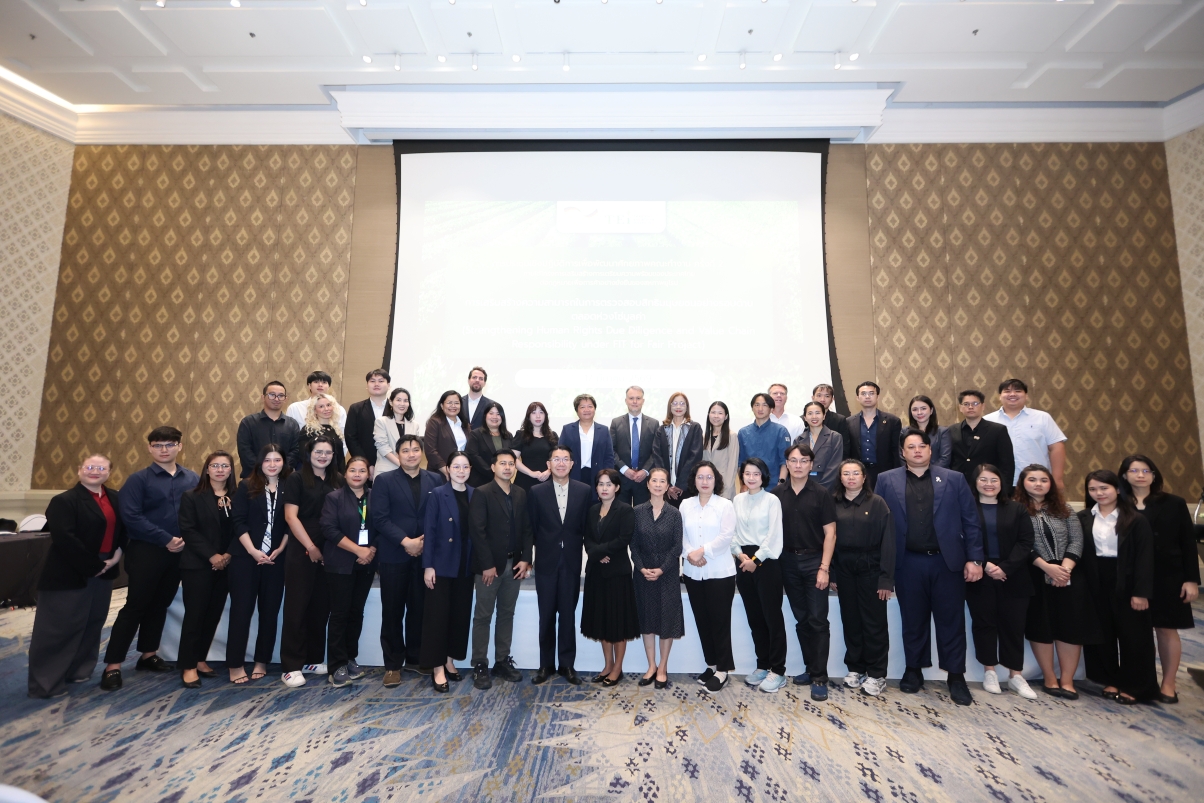
Following the workshop held on 19–20 February 2026, which focused on strengthening shared understanding of traceability and environmental management under EU due diligence regulations, Thailand has continued this discussion by moving into a deeper exploration of the social dimension of sustainability. Through the collaboration between GIZ and the Thailand Environment Institute (TEI) under the FIT for FAIR project, financed by The Federal Ministry for Economic Cooperation and Development (BMZ), a second capacity-building workshop, “Strengthening Human Rights Due Diligence and Value Chain Responsibility,” was organized on 17 March 2026 at Pullman King Power Bangkok. Building on the earlier workshop’s emphasis on data gaps, fragmented systems, and agricultural land management challenges, this session shifted the focus toward human rights risks, grievance and remedy mechanisms, and stakeholder preparedness for emerging Human Rights Due Diligence requirements.
The workshop brought together representatives from government agencies, the private sector, academia, civil society, and relevant commodity value chain stakeholders to exchange knowledge and identify practical approaches for responding to increasingly stringent international due diligence requirements.
The workshop commenced with welcoming remarks by Mr. Julian Tost, Project Director of the FIT for FAIR Project at GIZ Thailand. Dr. Inti Schubert, Advisor of the FIT for FAIR Project, then provided an inspirational message. Dr. Jeeranuch Sakkhamduang of the Thailand Environment Institute (TEI) followed with an introduction to the workshop's rationale and objectives, emphasizing the growing need to embed human rights considerations within traceability frameworks and sustainable value chain management.
Key sessions focused on the Corporate Sustainability Due Diligence Directive (CSDDD) and the current status of human rights issues in Thai value chains. The programme also covered practical approaches to conducting Human Rights Due Diligence (HRDD), stakeholder mapping, preparing evidence of procedures to support due diligence processes, and strengthening grievance and remediation mechanisms.
The workshop also featured a panel discussion, “Voices from the Ground on Due Diligence,” bringing together perspectives from labor, ethnic group representation, gender equality and non-discrimination. These discussions helped deepen participants’ understanding of how human rights risks are experienced in practice across supply chains and among affected stakeholders.

Share: