Thailand’s plastic waste management under the circular economy framework has evolved through a series of policy initiatives aimed at addressing plastic pollution, particularly single-use plastics (SUPs), which have become a major global environmental concern.
Thailand has established a clear policy direction through the Roadmap on Plastic Waste Management (2018–2030), supported by Phase I and Phase II Action Plans. In addition, various awareness campaigns and incentive-based award programs on waste management have been implemented at different levels. These efforts are aligned with Thailand’s Bio-Circular-Green (BCG) Economy Model and the 13th National Economic and Social Development Plan, with the shared objective of promoting a circular economy while reducing environmental impacts.
Thailand has primarily relied on voluntary measures to reduce the consumption of SUPs. These include campaigns encouraging department stores and large retail chains to discontinue the distribution of plastic shopping bags, the promotion of environmentally friendly alternative products, and continuous public awareness campaigns. Although these measures have achieved only modest reductions in plastic bag consumption, they demonstrate the important role of the private sector and consumers in driving behavioral change.
Nevertheless, further progress will require clearer product standards, stronger economic incentives, and more consistent public communication to encourage long-term behavioral shifts.
Despite significant policy progress, Thailand continues to face several critical challenges in legal frameworks, infrastructure, and local waste management capacity. Many existing measures remain voluntary, while enforcement varies considerably across localities due to limitations in budgets, human resources, and standardized implementation practices. Furthermore, source segregation and packaging take-back systems have not yet been established as legal requirements, resulting in fragmented plastic waste management across the value chain. Institutional responsibilities also remain fragmented, particularly among agencies responsible for production and manufacturing, where producer accountability for post-consumer plastic packaging has yet to be clearly defined.
A key challenge for Thailand is to transition from reliance on voluntary initiatives toward a stronger regulatory framework. In particular, the proposed Sustainable Packaging Management Bill seeks to introduce the principle of Extended Producer Responsibility (EPR), requiring producers and importers to assume responsibility for the collection and recycling of post-consumer packaging.
Thailand’s experience demonstrates that achieving sustainable reductions in plastic pollution requires an integrated approach combining clear policy direction, effective legal mechanisms, investment in waste management infrastructure, and active collaboration among government agencies, the private sector, and the public. Such coordinated efforts are essential for advancing a truly circular economy.
Reference:
Chotthong, B., Ngamsa-ard, Y., & Boonyoung, S. (2026).
Plastic waste management in Thailand: Policy challenges and lessons from voluntary initiatives to reduce SUPs. In F. Iwasaki, R. Kawamura, M. Kojima, P. J. D. Gamaralalage, & Y. Hotta (Eds.),
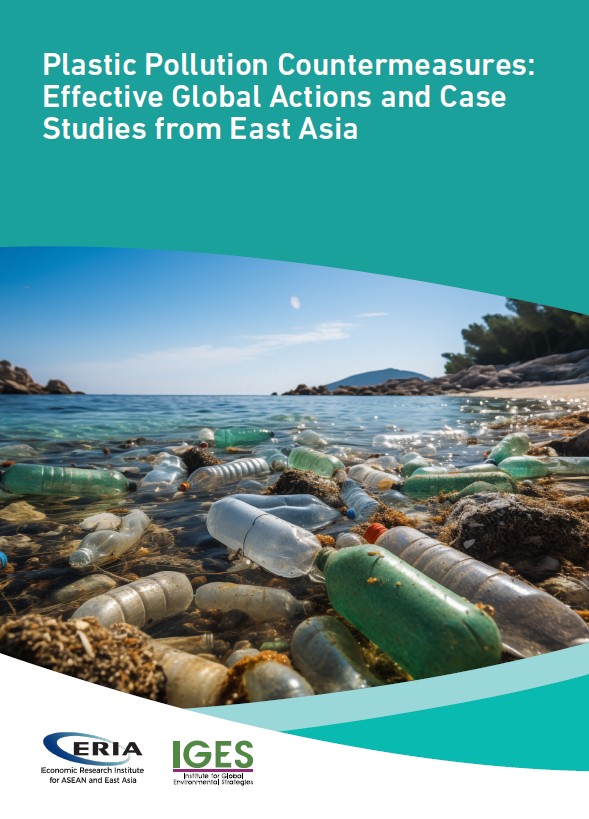
Plastic Pollution Countermeasures: Effective Global Actions and Case Studies from East Asia (pp. 411–422). Economic Research Institute for ASEAN and East Asia (ERIA).
Original publication:
https://www.eria.org/publications/plastic-pollution-countermeasures--effective-global-actions-and-case-studies-from-east-asia



Share: